|
|
Vrhunska poslovna prilika za sve!!!!!!!
detaljnije
|
|
|
|
|
Poseban dar
Besplatno učlanjenje uz kupovinu.
-25% zauvijek
Kao član možete naše
preparate i preporučivati te zarađivati i graditi vlastiti posao
širenjem mreže. Dovoljno je da vlastito iskustvo prenesete svojim
poznatim i vaš posao starta. |
| |
|
The Traditional
Chinese Secret for Maintaining Health
 |
With
a history dating back several thousand years,
the traditional Chinese health regimen
incorporates elements of natural science, human
studies, and social science. It distills the
experiences of health-preservation from
generations of Chinese, and distinguishes itself
among traditional regimens throughout the world
with its unique theoretical foundation and rich
clinical experiences. It has contributed greatly
to the well-being and health care of the Chinese
people.
|
|
|
Like
any other organism, human beings are not above
the natural laws of birth, growth, aging and
death. However, efforts can be made to promote
growth, improve the physique, and delay the
aging process so as to prevent premature death.
The key is proactive prevention and timely
treatment. According to material by Huang Di Nei
Jing written as early as the Spring and Autumn
Period and the Warring States Period, “A sage
cures a disease before it occurs and deals with
a disorder before it happens…” In other words, a
healthy person should take measures to prevent
disease, and if one gets ill, he/she should get
treatment as soon as possible to thwart the
development of the illness. A person who is good
at maintaining health often treats hidden damage
that may lead to disease and gets rid of all
risk factors lurking inside and outside the body |
|
 |
|
|
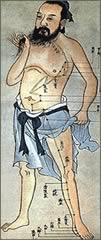
Chinese
medicine emphasizes the unity of man and nature as well
as that of all the tissues of the body system. Based on
the concepts of Yin, Yang, the five elements, and
“man-heaven harmony,” it views the human body as “being
able to resist the harmful qi pronounced, 'chi.'” Harmful qi is essentially any external element that
causes disease, i.e. bacteria or environmental toxins.
When the vital qi is inside the body (when the body's
systems are in balance and immunity is high)” and
“inevitably weak where the harmful qi dominates (unable
to fight off disease)”. Emphasis is put on the
principles of disease prevention, which allows for a
flexible approach in regards to a patient's prevention
program. Conclusions regarding the body's internal
condition are reached from observing and analyzing the
outward appearance of each individual. Thus, Chinese
medicine is committed to exploring the secrets of life. |
The role of
Cleansing, Replenishing, Strengthening, and Balancing in the
traditional Chinese regimen
-
As the basis of
longevity, health means the absence of harmful matter and
factors inside the body. Nowadays, people can be divided
into three categories: the healthy, accounting for 5% of all
people, the sick, 15%, and the predominately sub-healthy, at
approximately 80%. The sub-healthy are in a dangerous state
characterized by the constant presence of hidden damage,
which has yet to cause significant inconveniences. Such
people need to CLEANSE the spleen, stomach, and intestines,
REPLENISH qi, the blood, Yin and Yang, and STRENGTHEN
nutrition that is deficient so as to reach the health care
goal of BALANCING.
-
The human body
is an organic whole, where an imbalance between Yin and Yang
will lead to the malfunctioning of the internal organs. When
1 organ gets damaged, all the others are affected, which
results in an imbalance in the human body. Therefore,
unfavorable factors should be removed from the body
beforehand by restoring balance and strengthening nutrition.
As stated above, “the body is able to resist the harmful qi
when the vital qi is inside.” When the harmful qi enters the
body, the vital qi actively combats it; the subsequent
struggle disturbs the balance between Yin and Yang in the
body or causes the internal organs to malfunction, which
results in the operational disorder of qi and blood
reflected by a series of pathological changes. If the vital
qi prevails and the harmful qi recedes, the disease tends to
improve and be cured. If the vital qi is weak and the
harmful qi dominates, the disease tends to worsen and even
leads to illness and death.
Maintaining good
health and “man-heaven harmony”
-
The above shows
how important it is for people to preserve their health on a
daily basis. Usually, when one does not have any diseases,
she/he easily overlooks the pathological factors hidden in
the body and considers himself/herself to be healthy.
However, “a huge dam can be ultimately destroyed by
seemingly insignificant ant holes.” The body is like that
dam, which can only be saved from harm by ridding itself of
latent risks beforehand. However, people often only begin to
act after they are diagnosed with a disease. As the saying
goes, “A three-foot-thick layer of ice is not caused by one
day of wintry rigor.” In order to have health that is as
strong as ice, one must pay attention to health preservation
at regular intervals. Thus one can easily fend off the
onslaught of epidemics. How should a person conserve ones
health? Everyone needs to understand that because man lives
in nature and depends on the interactions of Yin, Yang, and
the five elements for his balance with nature, adjustments
should be made according to differences in season, region
and time zones which meet the individual conditions of the
patient. Only in this way can “man-heaven harmony” be
realized.
Yin, Yang, and the
five elements; the contradictory unity of nature
-
The human body
is an integral whole. Nothing can exist without Yin and Yang.
As the saying goes, “a single Yin does not grow; a lone Yang
does not survive.” The world is an actually integrated as a
result of the contradictory unity of Yin and Yang. Yin and
Yang represent the properties of matter that are both
contradictory and related. Neither man nor nature is
separable from the five elements – metal, wood, water, fire,
and earth. The property of wood is Yang because it grows and
connects. Water is a property of Yin because it flows
downward. Fire is attributed to Yang because it goes upward.
But Yin and Yang are intermingled. For example, the surface
of water is Yang but its bottom is Yin. This explains the
integral concept of the contradictory unity of Yin, Yang,
and the five elements, which interact with man and nature to
form a balance of gain and loss by promoting and restricting
each other. In a state of balance, for instance, the body's
five internal organs (the liver, heart, spleen, lungs and
kidneys) promote each other to make the body strong with a
prolonged life. On the other hand, damage to any of the
organs will affect all the rest.
Yin, Yang, the five
elements and the processes of Cleansing, Replenishing,
Strengthening, and Balancing
-
The so-called
five elements in traditional Chinese medicine, wood, fire,
earth, metal, and water, are the fundamental building blocks
of the world. They correspond to spring, summer, middle (long
summer), autumn, and winter in nature, and the liver, heart,
spleen, lungs, and kidneys in the human body. Accordingly,
we should take the corresponding actions of cleansing in
spring, replenishing in summer, strengthening in autumn, and
balancing in winter to achieve balance among the body,
ecology and nature. In today's world, environmental
pollution is severe, which inevitably results in harmful
substances being contained in our food. When these harmful
substances encroach on the body, the first organs affected
are the spleen and stomach, which are responsible for
digestion and assimilation. They are also the fundamental
organs of postnatal development and the source of qi and
blood. Furthermore, the extent of damage to the spleen and
stomach determines the sufficiency of innate vitality (qi
from the kidneys). Energy required by the body is sent all
over the body after digestion and assimilation by the spleen
and stomach, and then adjusts qi and blood in the liver and
lungs and supplements vitality in the kidneys, thus
preventing the onset of disease. When one uses healthcare
products, one should take into consideration the seasonal
influences of climatic changes instead of using them
indiscriminately.
|
|
| |
|
TIENS
Vodeća
kompanija u svijetu na polju kineske tradicionalne mudrosti.
To
potvrđuju milioni osoba koje koriste naše preparate.
|
Zglobovi i
hrskavica
Glucosamin (biljni)
Chondroitin (morski)
Ekstrakt Agaricus blazei
Kurkuma (95% Curcumina)
Ekstrakt đavolje kanđe
Hyaluronska kiselina
|
|
|
Pročišćivač voća i povrća

|